In the lifecycle of a business, legal compliance is often viewed as a checklist: tax registrations, municipal licenses, and incorporation documents. However, there is a critical distinction between the licenses that allow you to operate and the legal protections that allow you to own your brand.
Many entrepreneurs and established businesses operate under the misconception that incorporating a company or buying a domain name grants them ownership of their brand identity. It does not. Without a robust Intellectual Property (IP) strategy, the goodwill you build over decades remains vulnerable to theft, dilution, and imitation.
As senior legal advisors, we often see businesses approach IP only when a crisis hits—a competitor copies a logo, a former employee steals a client list, or a “cease and desist” notice arrives. This reactive approach is costly and dangerous. This guide abstracts years of legal experience into actionable insights, positioning your intellectual property not just as a legal right, but as a critical financial asset.
Why Intellectual Property Matters: Beyond the Logo
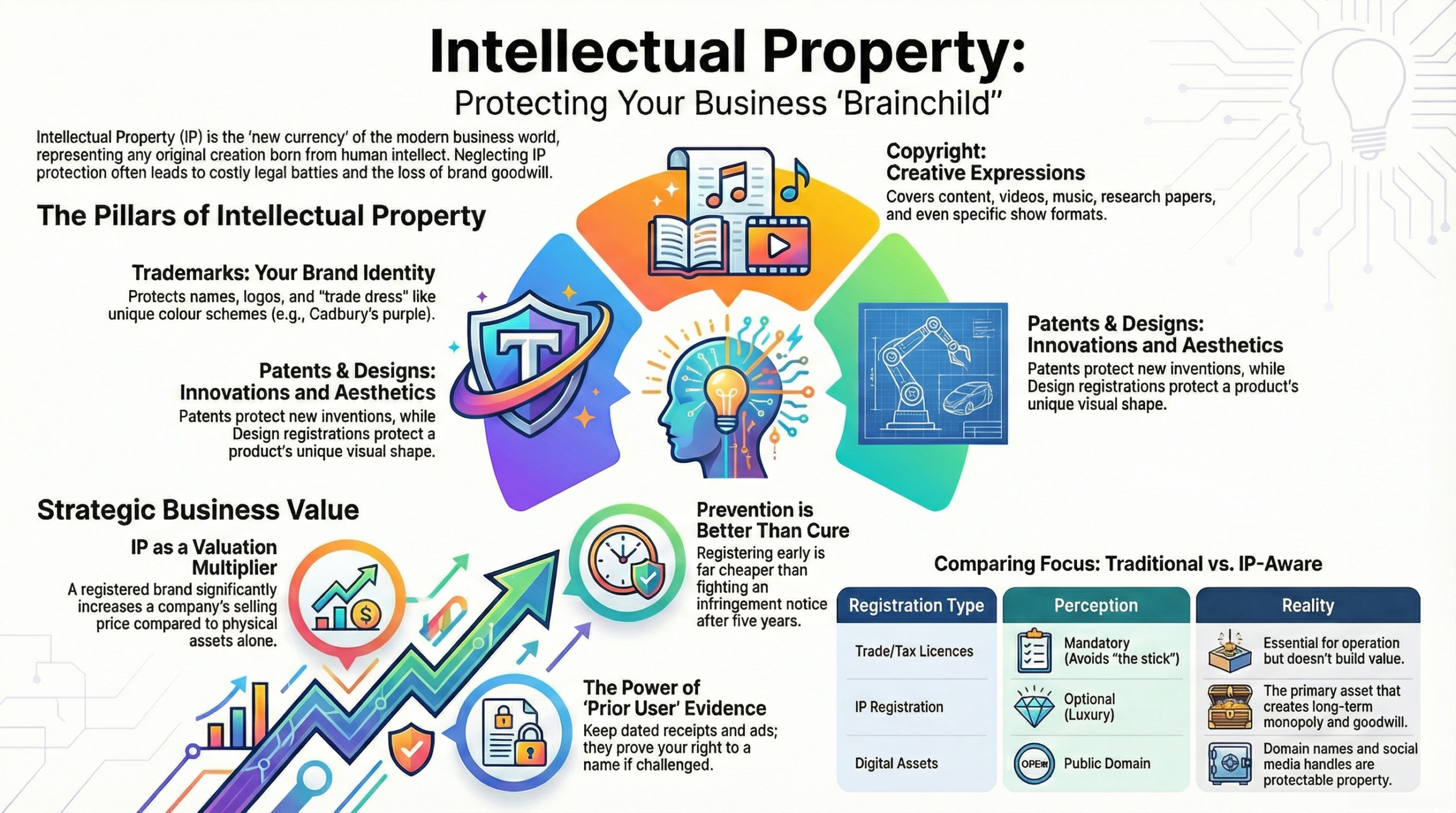
Intellectual Property is often misunderstood as merely “getting a logo trademarked.” In reality, IP acts as the protective shell around your entire business model. It is the legal mechanism that converts intangible effort—your reputation, innovation, and creativity—into a tangible, sellable asset.
The Concept of “Goodwill” as Currency
When a business is sold or seeks investment, the buyer is rarely paying for the physical inventory or the rented office space. They are paying for the Goodwill—the trust and recognition associated with the brand name.
- The Valuation Factor: A generic shop in a prime location has a ceiling on its value. A branded establishment with a registered trademark has a value that exceeds its physical assets because the brand ensures customer retention.
- Asset Depreciation vs. Appreciation: Physical machinery depreciates. A well-protected and managed IP portfolio appreciates over time, increasing the company’s overall valuation.
The Risks of Neglect
Operating without IP protection is akin to building a house on land you do not own. You may build the business for ten years, only to receive a legal notice from a competitor who registered the name yesterday.
- Rebranding Costs: Being forced to change your name after years of operation destroys your market recognition.
- Loss of Customer Base: If a competitor uses a similar name and you cannot stop them, your customers may unknowingly migrate to the inferior service, damaging your reputation.
Key Legal Insights: Understanding the IP Framework
To navigate the legal landscape effectively, business owners must understand the nuances of the law. Here are the core principles that govern IP protection.
Company Registration ≠ Trademark Rights
A common and fatal mistake is assuming that registering a company name (e.g., under the Companies Act) or obtaining a GST number protects your brand.
The Insight: Company registration identifies who you are to the government for tax purposes. Trademark registration grants you the exclusive right to use a name in commerce. These are legally distinct. A government body may allow you to incorporate “XYZ Technologies Pvt Ltd,” even if “XYZ” is already a registered trademark owned by someone else. Using that name commercially could still invite a lawsuit.
The Scope of “Trade Dress” and Packaging
IP protection extends far beyond the brand name. It covers the “look and feel” of your product or establishment.
Visual Identity: The shape of a bottle, the color scheme of a wrapper, or the unique interior décor of a retail store can be protected under “Trade Dress” or “Industrial Design.”
Consumer Psychology: If a consumer identifies a product solely by its unique shape or color combination (even without reading the name), that visual element is intellectual property and can be protected from copycats.
Prior User Rights: The “First to Use” Principle
What happens if you never registered your trademark, but have been using it for 20 years, and someone else registers it today?
The Legal Principle: Common law recognizes “Prior User Rights.” If you can prove via evidence (invoices, advertisements, third-party mentions) that you have been using the mark continuously prior to the applicant, you may defeat their registration.
The Caveat: Litigation to prove prior use is expensive and time-consuming. Registration acts as prima facie evidence of validity, shifting the burden of proof to the attacker. Prevention is always cheaper than the cure.
Digital IP and Virtual Jurisdictions
In the digital age, IP theft is borderless. Your content, social media handles, and website code are assets.
Social Media Assets: A business page with 50,000 followers is a commercial asset. If a “cybersquatter” creates a confusingly similar profile to divert your traffic, this is a violation of your IP rights.
Platform Enforcement: Modern legal strategies involve not just court orders but leveraging platform-specific Dispute Resolution mechanisms to takedown infringing content on social media and search engines.
Professional Best Practices for Business Owners
Drawing from high-level legal advisory, here is how professional entities should manage their IP.
The “Audit and Secure” Framework
- Conduct a Clearance Search: Before printing letterheads or launching a website, have an IP attorney conduct a comprehensive search. Do not rely on a simple Google search. You need to search the Phonetic and Vienna code databases of the Trademark Registry.
- File Early (The “Intent to Use”): You do not need to wait until you launch to file. You can file on a “Proposed to be Used” basis to secure priority dates.
- Document Everything: Maintain a repository of “User Evidence.” This includes the very first invoice issued, dated marketing brochures, and media features. This paper trail is your primary weapon in a dispute.
Specialized Representation Matters
Intellectual Property is a hyper-specialized field involving specific tribunals and registries.
- The Generalist Trap: A general corporate lawyer or criminal attorney may not be versed in the procedural nuances of the Trademark Registry or Copyright Societies. IP litigation often starts at the Registry level, not the District Court. An error in the classification of goods (Nice Classification) or a missed deadline for a counter-statement can lead to the abandonment of your rights.
- The Specialist Advantage: An IP expert understands the intersection of commercial law, technology, and branding, ensuring that your application survives scrutiny and opposition.
Navigating Licensing and Events
For businesses in the hospitality and event sectors, copyright licensing is a complex hurdle. Playing recorded music or hosting live performances involves third-party rights (Public Performance Rights).
- The Risk: Copyright societies often send notices demanding exorbitant fees for licenses (like PPL or IPRS).
- The Professional Approach: Do not simply pay the first demand. A legal expert can determine:
- Is the event private or commercial? (Fair use exceptions may apply).
- Are the requested tariffs in line with the published rate cards?
- Are you being asked to pay for licenses you do not need (e.g., paying for video rights when only audio is played)?
- Strategic Advice: Negotiate based on the actual usage and audience size, rather than the “package” offered by agents.
| Mistake | Consequence |
| Ignoring Office Actions | If the Registry raises an objection and you fail to reply within the statutory period, your application is abandoned. |
| DIY Filings | Incorrectly categorizing your goods/services limits your protection scope. |
| Using Descriptive Names | Names that describe the quality or location (e.g., “Best Indore Sweets”) are often rejected or hard to protect. Unique, coined words are strongest. |
| Waiting for Success | Protecting the brand after it becomes famous is often too late; squatters may have already taken the name. |
When to Seek Legal Help: Consultation Triggers
You should consult an IP specialist if:
- Launch Phase: You are naming a new company, product, or app.
- Expansion Phase: You are franchising, licensing, or expanding into new geographies.
- Digitization: You are taking a brick-and-mortar business online (risk of domain/social media theft).
- Conflict: You receive a “Cease and Desist” notice or notice a competitor copying your assets.
- Valuation: You are preparing for a merger, acquisition, or investor due diligence.
Expert Tips: The IP Checklist
- Trademark: Have you secured the name and logo?
- Copyright: Do you own the code to your website and the content of your marketing materials? (Ensure freelance contracts assign rights to you).
- Trade Dress: Is your packaging unique? Can it be registered?
- Digital: Have you secured all relevant social media handles and domain extensions (.com, .in, .co.in)?
- Monitoring: Do you have a system to watch for new filings that mimic your brand?
FAQs
Q1: Can I trademark a color or a sound?
A: Yes, under specific circumstances. If a color or sound is distinctively associated with your brand (acquired distinctiveness) and serves as a source identifier, it can be registered. However, the burden of proof is high.
Q2: What is the difference between a Copyright and a Trademark?
A: A Trademark protects branding elements (names, logos, slogans) that identify the source of goods. Copyright protects original artistic, literary, or musical works (software code, books, jingles, photographs). A single product often needs both.
Q3: If I have been using a name for 10 years without registration, can I stop someone else from using it?
A: Yes, under the common law remedy of “Passing Off.” However, you must prove you have an established reputation and that the other party is misrepresenting their goods as yours. Registration changes this to a simpler suit for “Infringement”.
Q4: Is IP litigation always expensive?
A: Not necessarily. Many IP disputes are resolved through legal notices, opposition proceedings at the Registry, or mediation. Litigation is the last resort. A proactive strategy focuses on prevention and settlement.
Conclusion
Intellectual Property is not merely a legal hurdle; it is the foundation of modern business value. Whether you are a startup founder or a legacy business owner, the security of your brand defines your longevity in the market.